The Day 8.5 Million Computers Went to Sleep (And Didn't Wake Up)
On July 19, 2024, the world witnessed what is probably the most expensive single software update in computing history. CrowdStrike, an endpoint security company, pushed a routine configuration update to its Falcon sensor. Within minutes, around 8.5 million Windows machines started showing the Blue Screen of Death. Airlines grounded. Hospitals went dark. Banks froze. Supermarkets couldn't scan groceries.
And you know what?
Macs were completely fine. Just vibing. Sipping their overpriced coffee :p
This isn't a coincidence. This is architecture. Let me explain.
What Even Is "Kernel Access"?
Okay so quick refresher for those who (like me a year ago) treated the kernel as "that thing I know exists but never think about" xD
Your operating system has layers. Think of it like a building:
- Ring 0 (Kernel space): The basement where all the power switches, water supply, and electrical wiring live. Full control over everything.
- Ring 3 (User space): The floors above where normal apps live. They can request services from the basement, but they can't just walk down there and start flipping switches.
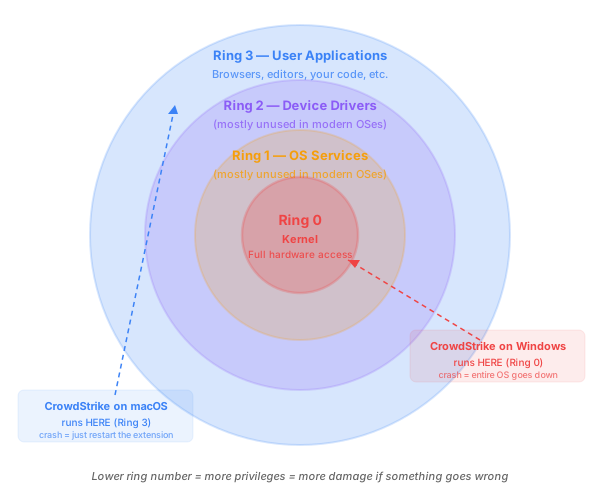
When a program runs in kernel space (Ring 0), it has unrestricted access to memory, hardware, and every other process. If it crashes, it doesn't just crash. It takes the entire building down with it. On Windows, that's the infamous Blue Screen of Death.
How CrowdStrike Killed 8.5 Million Machines
CrowdStrike's Falcon sensor runs as a kernel-mode driver on Windows. It's also registered as a boot-start driver, so Windows literally can't start without it. It sits at Ring 0 with full access to everything.
On July 19, a faulty configuration file (Channel File 291) passed CrowdStrike's validation due to a bug in their content verification process. When the Falcon sensor tried to parse this file, it triggered an out-of-bounds memory read in CSagent.sys. Since this was happening at Ring 0, Windows had no choice but to immediately halt.
Blue screen. Restart. Load CrowdStrike driver. Crash again. Blue screen. Restart. Infinite loop.
The fix? Manually booting into safe mode and deleting the offending file. On 8.5 million machines. One. By. One.
CrowdStrike reverted the update within ~78 minutes, but any machine that had already downloaded it was bricked until someone physically intervened. Hospitals. Airports. Banks. All needed hands-on-keyboard recovery.
So Why Was macOS Unaffected?
Because Apple simply said "Nah, you can't have kernel access. Go sit in user space."
Starting with macOS Catalina (10.15) in 2019, Apple officially deprecated kernel extensions (KEXTs), the mechanism that allowed third-party software to run code in the kernel. By macOS Big Sur (11.0), they basically told developers: "We're done here. Use System Extensions or go home."
The replacement? System Extensions and the Endpoint Security Framework. These run in user space. If they crash, they crash alone. The rest of macOS keeps running like nothing happened.
The Endpoint Security Framework gives security tools roughly ~100 event types to monitor: process execution, file access, network activity, all without ever touching the kernel. Apple built a nice observation deck with binoculars instead of letting security vendors run around the basement with flashlights and hammers.
The Origin Story: Why Apple Made This Decision
This wasn't some overnight decision. Apple spent over a decade getting fed up with kernel panics caused by third-party code.
Act 1: The XNU Kernel (1996)
macOS runs on XNU ("X is Not Unix"), a hybrid kernel that Apple inherited from NeXT (yes, Steve Jobs' other company). XNU combines the Mach microkernel from Carnegie Mellon University with FreeBSD's implementation. It was already architecturally set up for separating concerns.
Act 2: System Integrity Protection (2015)
With OS X El Capitan, Apple introduced SIP, a feature that prevents even the root user from modifying system files and processes. Before SIP, any software that got root access could rewrite system binaries, inject code into protected processes, basically do whatever it wanted. SIP drew the first hard line: "Root isn't god anymore."
Act 3: Deprecating KEXTs (2019-2020)
Apple had years of data showing that third-party kernel extensions were the #1 cause of kernel panics on macOS. A buggy kext doesn't just crash, it panics the entire kernel, forcing a restart. Sound familiar? (CrowdStrike. It sounds like CrowdStrike.)
So at WWDC 2019, Apple announced System Extensions as the modern replacement. By macOS 10.15.4 (March 2020), loading a KEXT would trigger a deprecation warning to the user. The message was clear: get out of our kernel.
Act 4: DriverKit and Full Lockdown
Apple also introduced DriverKit, letting hardware drivers (USB, network, etc.) run as user-space processes called Driver Extensions (dexts). Even hardware drivers don't need kernel access anymore. This is Apple going full microkernel philosophy for third-party code.
But Why Can't Microsoft Do the Same Thing?
Okay this part is wild :p
Microsoft actually wants to restrict kernel access. After CrowdStrike, they announced the Windows Resiliency Initiative and said they'd move antivirus software to user mode. But there's a catch.
The 2009 EU Agreement
In the early 2000s, the European Commission accused Microsoft of using Windows' dominance to give its own products an unfair advantage (remember Internet Explorer being bundled with Windows?). After years of legal battles, Microsoft signed an interoperability undertaking with the EU in 2009.
The agreement says: any API that Microsoft's own security software (like Defender) uses must be equally available to third-party developers.
Microsoft blames this agreement for why CrowdStrike had kernel access in the first place. A Microsoft spokesperson directly pointed to the 2009 EU undertaking when asked why the Windows kernel wasn't as protected as macOS.
The counterargument is that nothing in the agreement stopped Microsoft from building an out-of-kernel API that both Defender and third parties could use. Microsoft just... never built that abstraction layer. The EU agreement required equal access, not necessarily kernel-level access. But here we are.
Post-CrowdStrike Changes
Microsoft is finally doing what Apple did years ago. They're building a new endpoint security platform where security software runs in user mode (like normal apps), updates go through layers of testing before shipping, and a crash in a security tool won't take down the whole OS.
Only took a global outage to get there xD
What About Linux?
Linux is interesting because it sits in the middle. It allows kernel modules (loadable at runtime), but it also has eBPF, a technology that lets you run sandboxed programs inside the kernel without writing full kernel modules.
eBPF programs execute in a restricted virtual machine within the kernel. They're verified before execution to make sure they can't crash the system, can't access arbitrary memory, and will always terminate. Kernel access with training wheels and a safety net.
Many modern Linux security tools (like Falco, Cilium, Sysdig) use eBPF instead of kernel modules for exactly this reason. Linux went for a middle path: "You can peek into the kernel, but only through this heavily guarded window."
The Trade-offs
It's not all roses though :p
On the downside, user-space APIs will never have the same granularity as kernel-mode access. Some advanced threats that kernel-level tools could catch might slip through. And if there's a vulnerability that Apple's built-in tools (XProtect, Gatekeeper) miss, third-party vendors can't really compensate because they can't go deeper than what Apple's APIs expose. You're basically trusting Apple to get it right and keep their frameworks updated. If Apple's own kernel code has a bug, tough luck, nobody else can patch around it.
Enterprise teams also had a rough time. Organizations that relied on kernel-level security tools had to wait for vendors to rebuild their entire products using System Extensions. Some vendors took forever to migrate, leaving security gaps in the meantime. And the Hackintosh community? Pretty much dead because of this.
On the flip side though, stability is massive. A buggy security update literally cannot crash your OS anymore. CrowdStrike-style incidents are architecturally impossible on macOS. If a user-space extension crashes, macOS just restarts it without rebooting. No safe-mode manual fix needed. And less attack surface in kernel space means fewer ways for malware to gain persistent root-level access.
How All Three Compare
So you've got three very different philosophies playing out:
macOS blocked third-party kernel access entirely starting 2020. A bad driver can't crash the OS, security tools use user-space APIs, and recovery from a bad update is just an automatic extension restart.
Windows historically allowed kernel access (partly because of that EU agreement). A bad driver absolutely can crash the OS (we saw that), security tools run as kernel-mode drivers, and recovery from a bad update means manual intervention on each machine.
Linux gives you both options. You can use traditional kernel modules (dangerous, full access) or eBPF (sandboxed, verified, safe). Most modern security tools are moving to eBPF.
Apple picked stability and control over flexibility. Microsoft was forced (partly by regulation, partly by legacy) to keep the gates open. Linux said "here's a safe way and a dangerous way, you're adults, choose wisely."
The Irony
CrowdStrike is a security company. Their entire job is making systems safer. And because they had kernel-level access, access that was supposed to help them protect systems better, they accidentally caused the largest IT outage in history.
It's like hiring a security guard who accidentally locks everyone out of the building, sets off the fire alarm, and loses the master key. All in the same update. On a Friday :p
Apple saw this coming years ago and said: "What if we just... don't give anyone the keys to the basement?" Looking at July 19, 2024, that's looking like the right call.
PS: Microsoft is now basically copying Apple's homework with their Windows Resiliency Initiative. The student has become the... slightly-late copier? xD
Hope this gives you a good mental model of why your Mac survived the Great CrowdStrike Apocalypse of 2024 while Windows machines worldwide were having an existential crisis. The boring architectural decisions made years ago are what save you in the moments that matter.